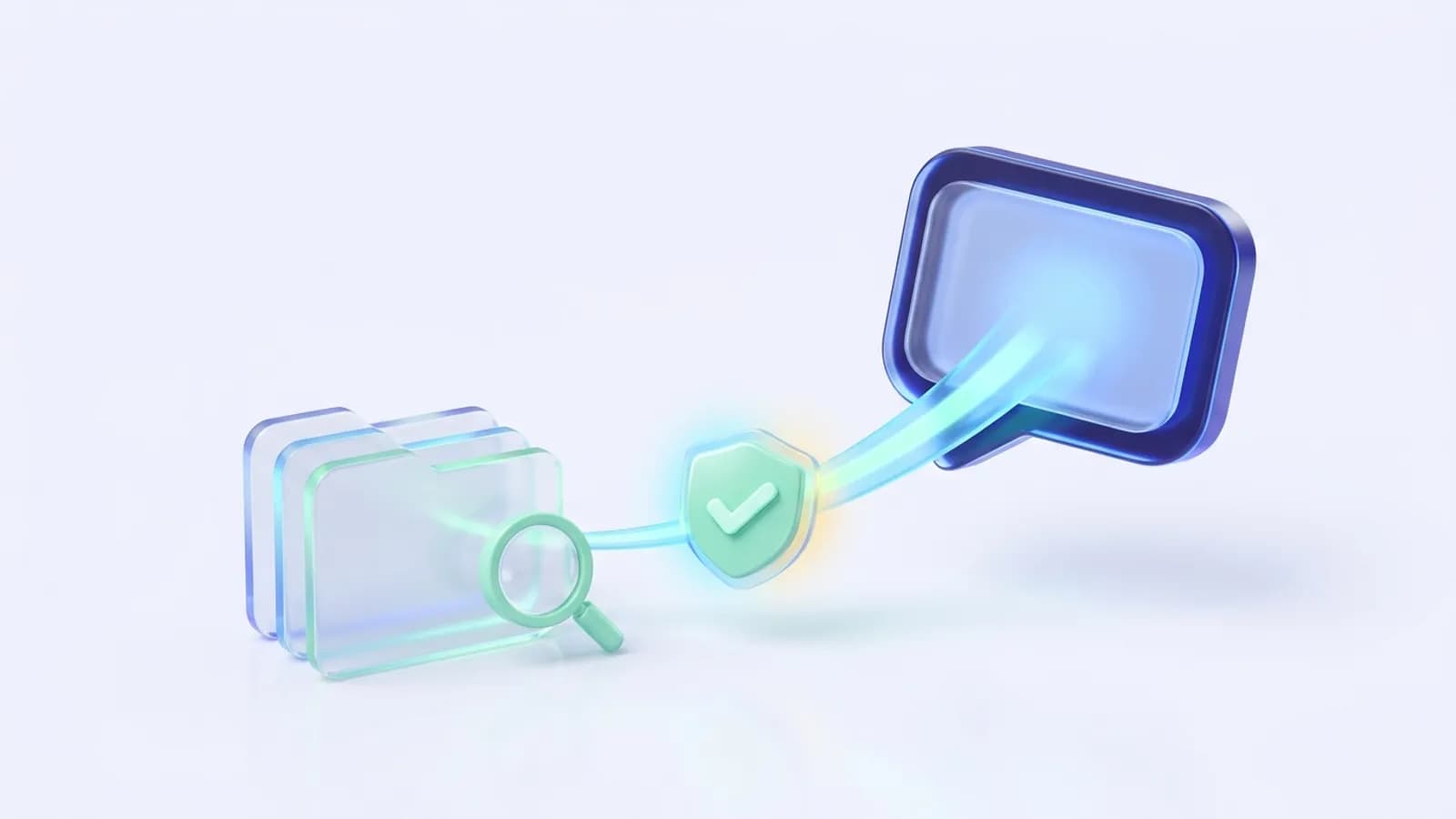
A RAG chatbot answers from your own documents. When a customer asks a question, it first searches your manuals, policies, price lists and FAQs for the relevant passages, then asks the AI model to answer using only those passages. This cuts made-up answers, keeps replies current and lets the bot show its source.
The most common complaint about AI chatbots is that they "make things up". Ask a general chatbot about your company's refund policy and it may write a confident, polite answer that has nothing to do with your actual policy. For a business, that is worse than no answer at all.
Retrieval-augmented generation, usually shortened to RAG, is the standard way to fix this. This guide explains how it works without jargon, what it costs to get right, and how to tell a good RAG chatbot from a weak one.
What does RAG mean?
The term comes from a 2020 research paper by Lewis and colleagues that combined a language model with a searchable store of documents. The idea is simple:
- Retrieval: find the passages in your own content that relate to the question.
- Augmented: add those passages to the request sent to the AI model.
- Generation: the model writes an answer based on that material.
Think of it as an open-book exam. Instead of answering from memory, the model is handed the right pages and asked to answer from them.
How does a RAG chatbot work, step by step?
- Collect the content. Product manuals, service pages, price lists, policies, past proposals, PDF brochures, help articles.
- Split it into passages. Each document is broken into sections of a few paragraphs, keeping headings so each passage still makes sense on its own.
- Index the passages. Each passage is converted into an "embedding", a list of numbers that captures its meaning, and stored in a search index. Many systems also keep normal keyword search alongside it.
- Search at question time. When a user asks something, the system finds the most relevant passages, by meaning and by keywords.
- Answer with instructions. The model gets the question, the passages and firm rules: answer only from these passages, say so if the answer is not there, and name the source.
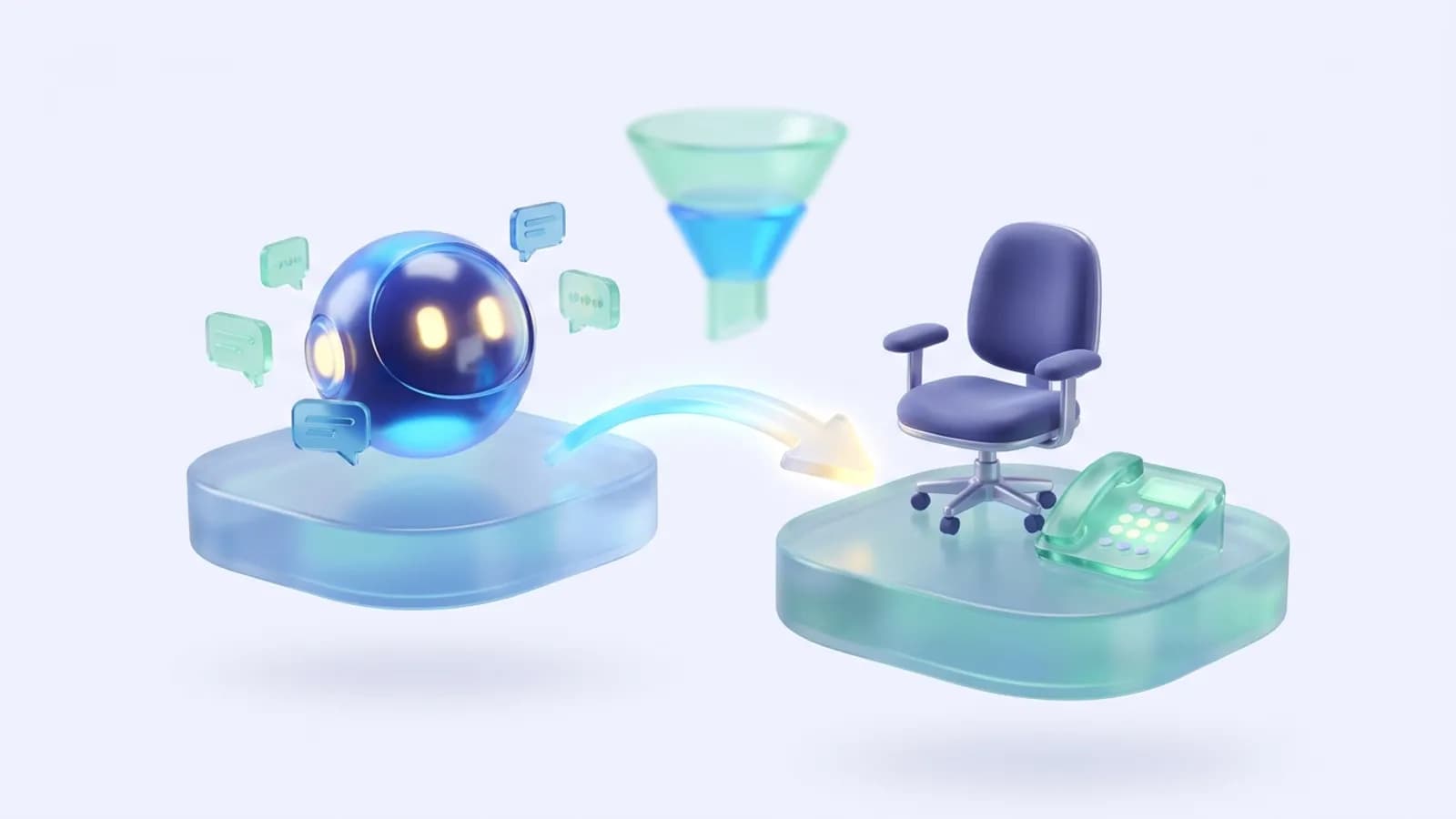
- Hand over when needed. If the bot cannot answer, or the user asks for a person, it passes the conversation to your team with the context.
Why not just train the AI on your documents?
Many people assume a custom chatbot means "training" or "fine-tuning" a model. For answering questions about your business, RAG is usually the better choice:
| RAG | Fine-tuning | |
|---|---|---|
| Updating content | Edit or upload a document; the bot uses it right away | Retrain the model for every change |
| Showing sources | Yes, it knows which passage it used | No, knowledge is mixed into the model |
| Made-up answers | Reduced, because answers are tied to retrieved text | Still possible, and harder to detect |
| Access control | Can limit which documents each user may see | Very hard once data is inside the model |
| Best used for | Facts, policies, product details, support answers | Tone, format or a specialised writing style |
The two can be combined, but most business chatbots never need fine-tuning.
What makes a RAG chatbot accurate?
The AI model gets the credit, but most of the accuracy comes from the less visible parts:
- Clean source content. If two documents give different prices, the bot will too. Remove outdated brochures and duplicate versions before indexing.
- Sensible splitting. A table cut in half or a passage without its heading loses meaning. Good splitting follows the document's structure.
- Hybrid search. Meaning-based search finds paraphrased questions; keyword search finds exact product codes, model numbers and names. Using both works better than either alone.
- Strict instructions. The bot must be told to say "I don't have that information" rather than guess.
- A test set. A list of real questions with correct answers, run before every change, catches problems before customers do.
- Metadata. Tagging passages by product, branch, language or date lets the bot filter, for example showing only the current year's fee structure.
Where do Indian businesses use RAG chatbots?
- Manufacturers and exporters in Gujarat: answering dealer questions from product catalogues and technical sheets.
- Schools, coaching institutes and colleges: admissions, fee and timetable questions from the prospectus and circulars.
- Real estate developers: project details, floor plans, amenities and approval status, with handover to sales for site visits.
- Hotels and resorts: room types, policies, packages and local directions, linked to the booking engine.
- Internal helpdesks: HR policies, SOPs and IT guides for staff, with access limited by role.
What are the risks, and how do you control them?
- Wrong or old documents: set an owner for each document set and review it on a schedule.
- Private data exposure: do not index payroll files or customer records into a public chatbot. Keep public and internal knowledge bases separate.
- Prompt injection: users may try to make the bot ignore its rules. Limit what the bot can do, and never let it take actions such as refunds without checks.
- Personal data: chat logs with names and phone numbers fall under India's data protection law. See our guide to DPDP Act compliance for AI chatbots.
- Cost creep: sending too many passages with every question raises the AI bill. Retrieve a few good passages, not dozens.
How long does it take to build one?
A focused RAG chatbot for one website and a modest document set can often be built in a few weeks, most of it spent on content clean-up and testing rather than code. Larger projects with many document types, user logins, several languages or CRM integration take longer. The timeline depends mainly on how organised your documents are today.
A sensible plan:
- Start with the 50 most common customer questions and the documents that answer them.
- Launch on one channel, usually the website, with a clear handover to a person.
- Read the unanswered questions every week and add or fix content.
- Expand to WhatsApp, more languages and internal users once accuracy is steady.
FAQs
Can a RAG chatbot read PDFs and scanned documents?
Yes. Text PDFs can be indexed directly. Scanned documents need text recognition (OCR) first, and the result should be checked, especially for tables and Indian-language text.
Does RAG completely stop wrong answers?
No, but it reduces them a lot. With strict instructions, good retrieval and testing, the bot answers from your content and says when it does not know. Regular review of conversations is still needed.
Can the chatbot answer in Hindi or Gujarati from English documents?
Yes. Modern models can read English passages and reply in Hindi or Gujarati. Have a native speaker check key answers, especially for prices, dates and legal terms.
Do I need to share my documents with the AI company?
The relevant passages are sent to the model with each question. Use a business API plan whose terms exclude your data from training, or a self-hosted model if your documents must stay on your own servers.
How do I keep the chatbot up to date?
Update the source documents. A good setup re-indexes changed files automatically, so the next answer uses the new content without retraining anything.
Want a chatbot that answers from your own documents?
We build RAG chatbots for websites, WhatsApp and internal teams, with source-checked answers, human handover and CRM integration. See our AI chatbot development service, our ChatGPT developer service for custom builds, or contact our team with a sample of your documents.